

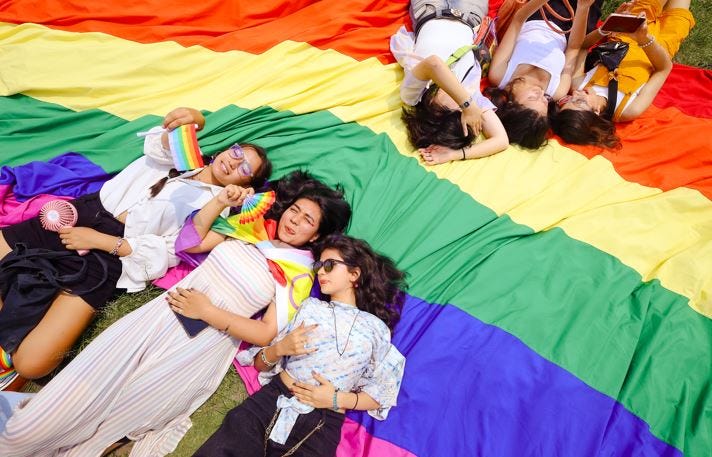
It’s June – pride month! It is a time for parades and to celebrate love and self-expression. On June 8, three weeks ago, the queer community in Nepal held its own pride parade, as it does every year. This year too, the parade was vibrant, full of life and love, showcasing powerful solidarity. The celebrations demonstrated a yearning to be seen, a unique sense of emotions and the changing times.
Globally, Nepal is seen as a beacon for LGBTQ+ rights in Asia. Nepal ranks 29th on the LGBTQ equality index, primarily due to some progressive legislation and strong judicial stances. However, while Nepal scored 83 out of 100 on the legal index, it only scored 61 on the public opinion index showing that legal measures have not translated into societal acceptance. But even this took years of struggle and the queer community had to put up a great fight to stand where we are today.
In 2007, the Supreme Court, in Sunil Babu Pant v. Government of Nepal, recognized LGBTI persons as equal citizens and held that the state was responsible for providing identity documents that reflected an individual’s self-declared gender identity. Going even further, the Supreme Court stated clearly that “gender non-conformity and same-sex orientation were not results of mental perversions or emotional or psychological disorders.” The Court ordered the government to legally recognize a ‘third gender’ category and form a committee to study the legal recognition of same-sex marriage.
Following this landmark decision, the government of Pushpa Kamal Dahal Nepal introduced its first implementation measure in the 2008 federal budget, which stated: “The state will accord special priority to solve the core problems of Nepali people relating to sexual and gender minorities…” This marked the first time any Nepali government had mentioned the umbrella term ‘sexual and gender minorities’ in an official context.
Following much discourse and advocacy, Bishnu Adhikari, in 2008, became the first Nepali citizen to gain official legal recognition as ‘third gender’ on his citizenship card. Then, in 2010, the Election Commission added the ‘third gender’ option to voter rolls, marking the start of actual inclusion measures by the government. The most sweeping implementation of the third gender category in Nepal was introducing a third gender option on the 2011 federal census, making Nepal the world’s first national census to include a third gender category.
After lengthy deliberations, the new Constitution of 2015 included several articles like Article 12, which allows citizens to choose their gender identity (male, female or other) on their official documents; Article 18, which specifically prohibits discrimination against gender and sexual minorities and pledges to create “special provisions by law for the protection, empowerment or development…of gender and sexual minorities”; and Article 42, which includes gender and sexual minorities among the groups who will receive inclusion provisions to participate in state bodies. Since then, the government has also tried to incorporate gender minorities by implementing information about sexual and gender diversity in the grades 7-9 curriculum, making Nepal the second Asian country to do so.
While these were commendable broad legislative measures, they have yet to translate into concrete action at the level of implementation. In 2015, a committee of experts formed to study the feasibility of same-sex marriage recommended that the government introduce and amend laws to legalize same-sex marriage. However, despite this recognition and despite being guaranteed equality before the law by the constitution, the new Civil Code, promulgated in 2017, still recognizes marriage as “a permanent, inviolable and holy social and legal bond…between a man and a woman.” It was only last year, in June, that the Supreme Court once again directed the government to establish an “interim registry of same-sex marriage” as a transitional mechanism while Parliament mulled over changes in law. It took almost another year for this decision to be implemented. Earlier this year, in April, the Home Ministry finally issued a circular ordering all government bodies to begin registering same-sex marriages.
Socially, Nepal remains deeply patriarchal and conservative. Legislative changes and judicial fiats have not translated into changes in societal attitudes. Many communities, especially outside of the urban centers, remain deeply homophobic, forcing many LGBTQ+ individuals to flee their homes for the cities. Even in cities like Kathmandu, finding education, residence, and employment can still be difficult. The queer community continues to face persistent harassment and physical attacks, even amounting to murder. Nepal’s rape laws, as outlined in the 2017 Criminal Code, still defines rape as a forceful act committed by a man against a woman, disregarding the experiences of queer individuals and cisgender males. Queer individuals also face much more harassment and cyberbullying on the internet. According to a 2023 UN Women survey of 1,181 individuals, four out of five LGBTQ+ respondents said that they had suffered from at least one form of violence. The same report concluded that “the main driver of violence against LGBTIQ+ communities was a patriarchal, heteronormative system.”
In the years since the 2007 Supreme Court decision, there have also been changes in the broader LGBTQ+ community. While older activists like Sunil Babu Pant advocated for a third gender category, many younger queer activists reject this label. Transwomen are women and transmen are men, they argue, not a separate ‘third gender’. “Transgender and intersex are proper categories. ‘Other’ as a gender category does not make sense,” a transgender individual told The Record in 2018. In February 2022, the Supreme Court, in Rukshana Kapali v. Election Commission et al., decided that a transwoman’s gender identity is ‘woman’, not third gender. Gay and lesbian individuals too feel slighted when they are lumped into the third gender category when they identify as cisgender men and women. Many more advocacy groups have taken root since the early days of Blue Diamond Society in the 2000s. These groups represent – and advocate for – the diversity within the queer community.
Amidst this complex and constantly evolving context, the Nepal government and various non-governmental organizations have decided to explore the possibility of turning Nepal into a ‘queer-friendly destination’ to attract high-spending LGBTQ+ individuals while also promoting inclusivity within the tourism sector. Last year, Nepal Tourism Board and UNDP Nepal provided a 35-day trekking guide training for 25 queer individuals. And earlier in April, Mayako Pahichan Nepal, in collaboration with the Nepal Tourism Board, organized a ‘Rainbow Tourism Conference’. Nepal ranks 44th among 203 countries and territories in the 2023 LGBTQ+ Travel Safety Index. It ranked first in Asia, followed by Taiwan at 48, India at 51, and Thailand at 62. So Nepal appears to be well-positioned to welcome queer tourists but much remains to be done.
Turning Nepal into a queer-friendly destination has to begin with the social and economic inclusion of the local queer community. It would be hypocritical to promote Nepal as a queer-friendly space for tourists when Nepali LGBTQ+ individuals are not wholly accepted, discriminated against, harassed, and attacked. While queer tourists may feel safe and welcomed during their stay here, locals too deserve to feel a sense of safety and acknowledgment. In any case, Nepal’s ‘pinkwashing’ plans will certainly backfire in the face of opposition from queer groups themselves.
The question we should be asking is: what has Nepal’s government done to celebrate and support the LGBTQ+ community? Thailand recently legalized same-sex marriage and introduced a Pink Plus economy package that seeks to invite queer individuals from across the world to “wed, live, play, innovate, plan a family and retire in the country”. Successive Nepali governments, on the other hand, have done the bare minimum to protect the queer community in Nepal and provide them with equal rights. It took over 16 years for Nepal to seriously consider same-sex marriage and that too only because of judicial fiat, not because of the government’s desire to support queer Nepalis. Nepal cannot take credit for laws, actions, and policies that were achieved by activists fighting tooth and nail. Ensure true equality for the LGBTQ+ community at home before inviting tourists to partake.